
Liquidity for Long-Term Investors
Understanding the marginal value of liquidity to long-term investors

It is counterintuitive to state that liquidity matters just as much to long-term investors as it does to hedge funds and day traders. However, recall that the most efficient home for any asset is within a diversified portfolio which requires systematic rebalancing back to target weights; executing these trades isn’t free and liquidity is the cost which swells in proportion to volatility. In this post, we’ll unpack why diversification demands periodic rebalancing, and how turbulent markets demand hefty liquidity bills. Understanding this interplay is key for investors who seek to harvest rebalancing gains without letting execution frictions erode their long-term returns.
Market Making & Bid-Ask Spreads
Market makers, by providing liquidity through continuous bid and ask quotes, are effectively short volatility. In volatile conditions, rapid price movements can quickly turn against their positions before they can adjust their quotes, exposing them to potential losses similar to a short option position. To compensate for this increased risk, market makers often widen their bid–ask spreads during periods of high volatility. This widening can be understood through the lens of option pricing: a market maker’s limit order essentially provides a free option to the market, with the bid resembling a written put and the ask a written call. As market volatility increases, the value of these implicit options rises, prompting market makers to expand their spreads to offset the higher option value and increased risk.
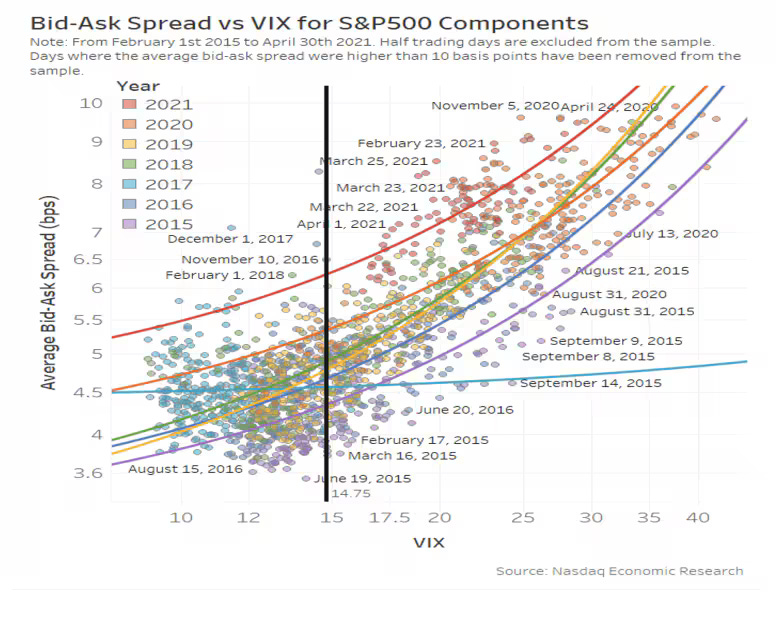
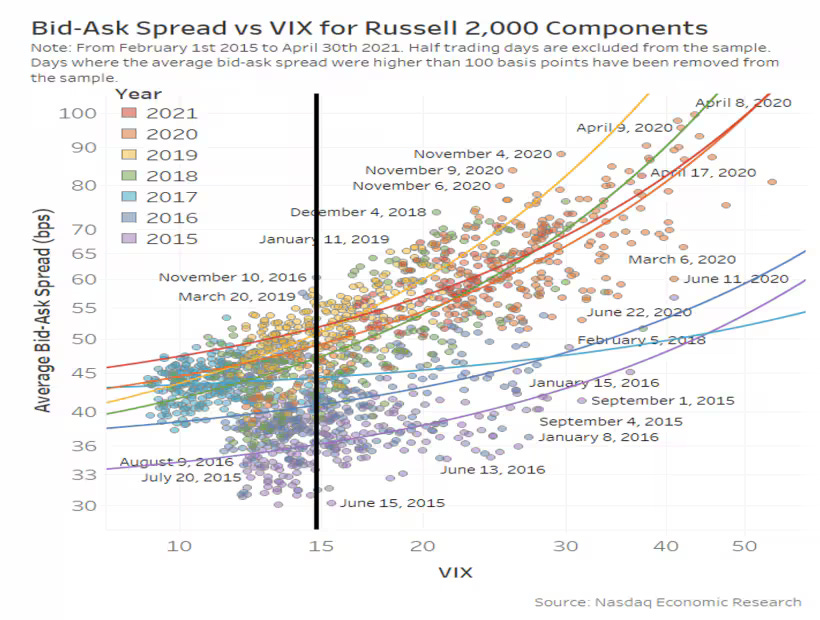
This relationship between volatility and liquidity is not merely theorical, but as we can see from NASDAQ data, the 1 month forward volatility of the SPX index correlates highly with the bid-ask spreads on individual SPX components. This relationship even holds for small caps not in the SPX index (see below).
Prices are Set on the Margin
The value of liquidity through optionality applies universally to all investors, regardless of their individual preferences or trading behaviors. Even for investors who adopt a hands-off approach—aware of their potential for suboptimal market timing or emotional decision-making—the inherent value of liquidity remains critical. Asset prices are set at the margin by participants who place a premium on liquidity. The pricing mechanism in financial markets thus reflects the aggregate demand for liquidity, not the desires of any single investor, so even those who do not intend to trade actively benefit from the liquidity premium embedded in marketable securities.
This dynamic is analogous to how certain features become standard in consumer products due to broad market demand, benefiting all consumers regardless of their individual preferences. Likewise, the liquidity discount applied to illiquid investments is driven by the market’s collective valuation of optionality and flexibility, not by the specific needs of any one investor.
In the same way, the value of a single stock held in isolation is lower than its contribution when held as part of a diversified portfolio. Diversification reduces idiosyncratic risk and enhances the optionality to rebalance across assets, thereby increasing the overall value of each position. Just as liquidity adds optionality and commands a premium, diversification amplifies each asset’s worth by embedding it within a broader, more liquid and flexible investment framework.
Rebalancing Premium
So far, we have described—both empirically (through observed spreads) and conceptually (through optionality)—that a premium exists for liquidity and that it expands during periods of increased volatility. However, for readers who are more mathematically inclined and would like to quantify these effects, those explanations may be unsatisfying. In the final part of this post, I propose the following definition of the “true” value of the liquidity premium for an investor: it is the risk-adjusted expected excess return earned by rebalancing a portfolio of liquid assets versus holding a static portfolio over the same investment horizon.
First, let’s build intuition for how rebalancing premiums arise. Claude Shannon—MIT professor, electrical engineer, World War II cryptographer, and “the father of information theory”—introduced the concept of Shannon’s Demon to show that a volatile asset with zero long-term return potential can become a positive contributor to portfolio growth simply through periodic rebalancing.
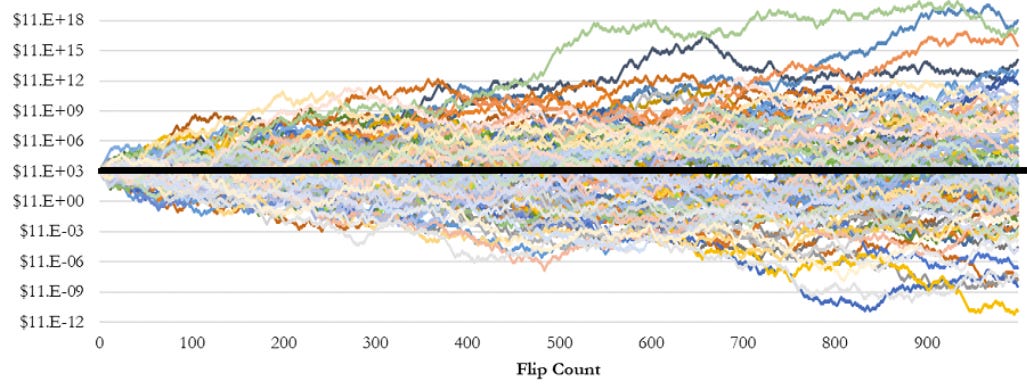
To illustrate, consider a coin-flip game: if the coin lands heads, you earn a 50% return; if tails, you incur a 33.3% loss. This game has an expected long-term compounded geometric return of zero. For example, start with $100 and invest it all: a heads flip yields $150. On the next flip, invest the entire $150; a tails flip then brings you back to $100. With a fair coin, your bankroll will oscillate around $100 over time, producing no net gain or loss—yet, when combined with rebalancing across multiple such assets, this volatility can be harvested into positive excess returns.
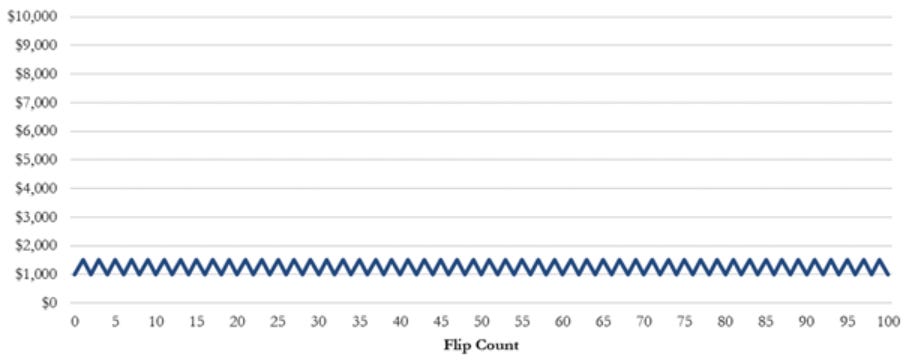
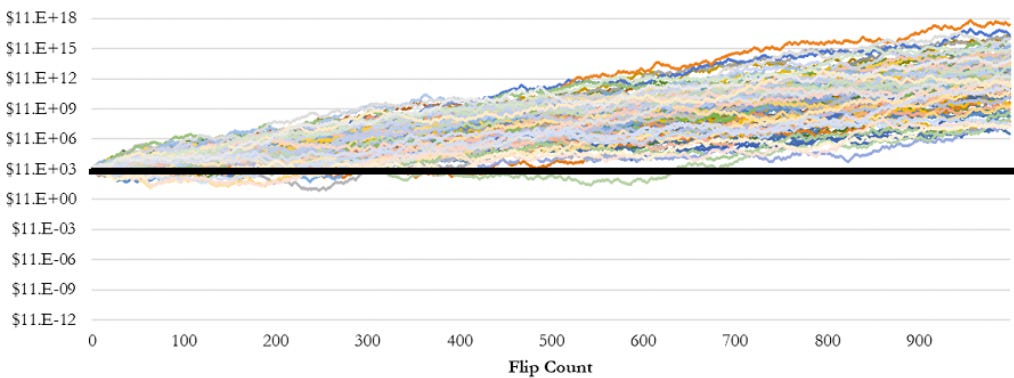
The situation becomes intriguing when considering a strategy of rebalancing 50% of the bankroll into cash after each coin flip, regardless of the outcome. Contrary to intuitive expectations, this approach significantly alters the long-term return profile. Although both the coin-flip game and cash have zero compounded (i.e., log) returns in this example, the rebalancing strategy converts these two zero-return streams into a wealth-generating mechanism.
Initially, the portfolio starts with $100, allocating $50 to the coin-flip game and $50 to cash. If the coin lands on heads, a $25 gain (50% return) is realized on the coin-flip portion while the cash remains unchanged. The portfolio now totals $125, which is then rebalanced to $62.50 in each component. If the subsequent flip results in tails, a $20.83 loss (33.3%) occurs on the coin-flip portion, while the cash again remains unchanged. The portfolio now stands at $104.17, which is again rebalanced equally between the two components. This process continues, with each flip and subsequent rebalancing potentially contributing to portfolio growth.
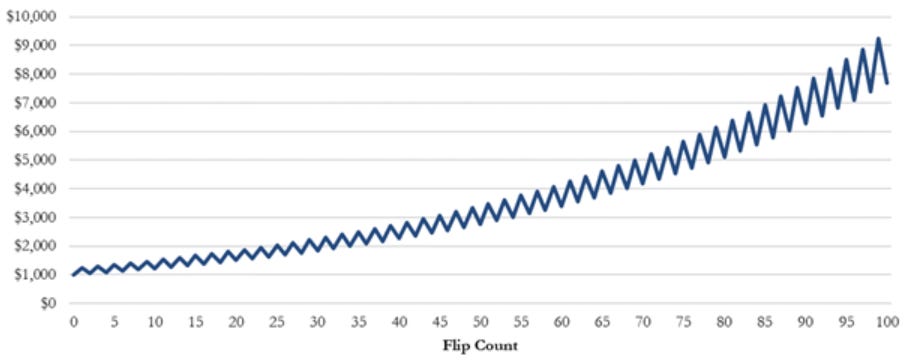
What’s happening here? This is a classic illustration of the AM–GM inequality: the arithmetic mean of returns always exceeds the geometric mean (i.e., the compound or log return). In fact, for a portfolio with arithmetic mean return μ and volatility σ, the long‐run compounded growth rate is
Clearly, the coin‐flipping game has positive expectancy, but its variance drives its compound growth rate to zero. By adding cash and retaining the option (i.e., liquidity) to rebalance, we lower the mean return μ but reduce σ² by even more, yielding a positive compounded growth rate.
If you begin with an allocation that maximizes μ − ½σ², asset returns will inevitably diverge over time, pulling you away from that optimum. Rebalancing back to your target weights restores the higher growth rate—provided you can trade. The value of liquidity can thus be measured as the difference in compound growth between a rebalanced portfolio and a static, illiquid one. Crucially, this growth‐rate gap widens nonlinearly—proportional to the square of volatility.
To build further intuition, consider Monte Carlo simulations of the coin‐flipping game without any rebalancing
versus paths that the game takes with 50% rebalancing towards cash
Indeed, diversifiers are powerful and have often been called the only free lunch in investing. But that’s not quite right. Asset prices are set by marginal traders; the diversification benefit an asset provides to a portfolio isn’t captured by someone who doesn’t diversify. In effect, nondiscriminating buyers overpay for that asset’s value. In other words, diversification isn’t merely a free lunch—it’s a negatively priced lunch.
The Value of Cash (i.e., Liquidity) when the Market is Volatile
Assuming that you are holding a combination of short-term treasuries that earn risk-free returns but also has no vol and the market portfolio where the returns are μ > r and volatility is σ with the proportion x going towards the market portfolio (this can be greater than 1 for leverage), your compounded growth rate is
To optimize growth rate, you should allocate
where s is the Sharpe ratio of the market. Note that this allocation is inversely proportional to volatility squared. The equation above assumes constant volatility, but in reality we know that volatility, while mean-reverting, also exhibits autocorrelation. Some argue you should hold whatever risky portfolio you had, even during a downturn—i.e., when volatility spikes—but the equation shows that’s simply wrong.
If you genuinely believe volatility is elevated in your economic environment, then you should (1) deleverage if you’re already leveraged and/or (2) hold some cash and rebalance whenever the value of your risky asset changes. Even if you assume your true μ remains at its long-run average (empirically close to IID), your views on σ (which is not IID) should still drive portfolio adjustments (though holding all cash is almost always the wrong call for most). Conversely, if volatility looks low and the economy seems healthy, it may be time to switch to a risk-on stance.
While these arguments on rebalancing premiums and portfolio tilts during volatile markets might sound like market timing, they’re not. These strategies don’t try to predict future returns; they focus on managing risk by responding to observable changes in market volatility. We acknowledge returns are notoriously hard to forecast, but volatility tends to exhibit more predictable patterns that can be leveraged for better risk management.
How Private Markets can be made Liquid
Bringing liquidity to traditionally illiquid asset classes—such as private equity, venture capital stakes, real estate, or art—can unlock substantial value for shareholders by allowing these investors to realize the same liquidity premium that public‐market participants enjoy. Private company shares, for instance, often trade at deep discounts precisely because there is no ready secondary market; sophisticated investors demand a higher expected return for this illiquidity. If those same stakes could be tokenized or synthetically traded via derivatives, investors could dynamically manage their risk exposures and capture the rebalancing premium we’ve described.
Blockchain‐based tokenization platforms, like Republic’s tokenized “futures” on private company equity, demonstrate one path forward. By issuing digital tokens that represent economic exposure to a private firm’s shares—and by automating settlement, custody, and transfer on‐chain—these structures create continuous, 24/7 markets for assets that were once locked up for years. Even if true spot trading of private equity remains legally constrained, properly designed derivative tokens (e.g., perpetual swaps or standardized futures) can give investors the optionality to adjust positions, hedge volatility, and rebalance their portfolios, effectively monetizing what was formerly a static, illiquid claim.
Extending this approach across a wider range of traditionally illiquid investments—commercial real estate, private credit, infrastructure, collectibles—could generate significant value for all stakeholders. Institutional allocators would gain more precise control over risk budgets and return targets, secondary markets would attract a broader base of capital, and companies themselves could benefit from more accurate price discovery and a lower cost of capital. In effect, tokenization and on‐chain derivatives can democratize access to the liquidity premium, transforming the entire private‐assets ecosystem into a more efficient, transparent, and value‐creating market.
Disclaimer
The information provided on TheLogbook (the "Substack") is strictly for informational and educational purposes only and should not be considered as investment or financial advice. The author is not a licensed financial advisor or tax professional and is not offering any professional services through this Substack. Investing in financial markets involves substantial risk, including possible loss of principal. Past performance is not indicative of future results. The author makes no representations or warranties about the completeness, accuracy, reliability, suitability, or availability of the information provided.
This Substack may contain links to external websites not affiliated with the author, and the accuracy of information on these sites is not guaranteed. Nothing contained in this Substack constitutes a solicitation, recommendation, endorsement, or offer to buy or sell any securities or other financial instruments. Always seek the advice of a qualified financial advisor before making any investment decisions.