
Stock Prices Can't be Smooth
Demonstrated with an illuminating options puzzle

Question is a variation on page 198 of Taleb’s Dynamic Hedging, graph from page 172 of Bennett’s Trading Volatility. No math involved for this post, just some concepts.
A friend recently asked me about a supposedly fool-proof scheme of his that involves selling naked calls on NVDA, which he claimed was risk-free. The reasoning goes that one should sell a call option on NVDA for the hefty premium that it commanded, then leave a stop loss to buy the full amount at the strike price; if the spot increased, then the stop loss will trigger and he will be able to cover his call. If the spot then decreased, he would sell his shares and leave a stop loss order again. Given this brilliant strategy, it appears that the options premium is just free money.
Without going into stochastic integration, how can we convince my dear friend that the strategy he proposed doesn’t work? I encourage the reader to think about this before reading the next few paragraphs.
A possible argument we could make to our friend is the cost of liquidity and trading in the real world. We could argue that the bid-ask spread, exchange fees, and slippage from the stop order would induce a cost on his strategy, and that the price of the option is equal to the market’s expectation of the cost of hedging. However, the natural question then is how we can justify options having premiums in the Black-Scholes world of continuous frictionless markets.
The key to [Geometric] Brownian Motion being the basis of modeling stock movements is that its non-differentiability is a desirable characteristic that can be used to approximate both the randomness and discreteness of real markets. Even in a frictionless world, making the time interval smaller does not make it more differentiable; the trader can choose to rebalance when the price is at an arbitrarily small distance away from the strike but she will never be able to trade exactly at the strike.
In a world where prices are continuously differentiable, the gamma exposure of the option can be kept arbitrarily small, and options would have no value. In fact, if prices were smooth anywhere there would be a hedging strategy that strongly outperforms others (consider replicating an options position with arbitrary Greeks exposures in the smooth interval for free). More generally, it would imply the ability to locally predict the movement of the stock using past prices; this would be consistent with all options prices (and vols) collapsing, since the asset is now risk-free (literally has no unhedgeable variance). As such, we see that the only permissible smooth function allowed to describe an asset’s price is a straight line with slope equal to the return of the risk-free asset.
Another principle the scheme illuminates is that the price of an option can be derived from the expected rebalancing cost at the strike (from buying and selling the full notional amount of the underlying); this cost is equal to the cost of continuously delta hedging the option across all strikes. This principle can be further extended to the fact that in a local volatility model (where volatility is a function of the spot, allowing for the existence of volatility skew and smile), the Black-Scholes implied volatility is the probability-weighted average volatilities of all paths between the spot and strike. See below:
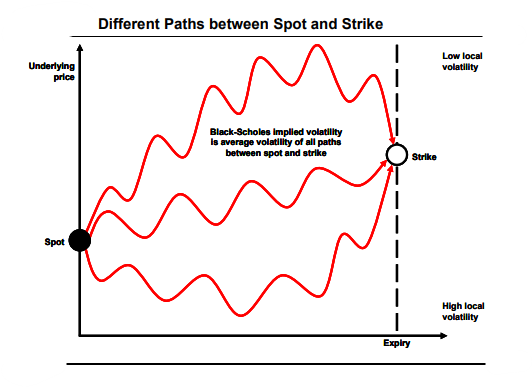
Note that there are many paths from spot to strike and depending on which path is taken they will determine how volatile the underlying is during the life of the option. Does this then imply that vanilla option prices are path dependent under the effects of skew and smile?
The answer is no. In particular, we use the observation that (1) the cost of rebalancing at the strike is equal to the cost of delta hedging continuously and (2) the frequency of hedging does not affect the expected payoff to reach the conclusion that while the realized volatility of the spot is path-dependent, we only need to hedge with the delta given by the path-independent implied vol at the strike of the option.
A reasonable approximation for the probability-weighted average volatilities of all paths (assuming some level of symmetry) is the simple average of all local volatilities on a straight-line between spot and strike. If the skew isn’t very steep, the effects of convexity can be ignored and this can be approximated by the ATM local volatility and the strike local volatility. It is somewhat strange that we hedge with the implied vol at the strike even though we know that the realized vol that the spot will take will almost surely be different, but then no one ever said options were intuitive.
Disclaimer
The information provided on TheLogbook (the "Substack") is strictly for informational and educational purposes only and should not be considered as investment or financial advice. The author is not a licensed financial advisor or tax professional and is not offering any professional services through this Substack. Investing in financial markets involves substantial risk, including possible loss of principal. Past performance is not indicative of future results. The author makes no representations or warranties about the completeness, accuracy, reliability, suitability, or availability of the information provided.
This Substack may contain links to external websites not affiliated with the author, and the accuracy of information on these sites is not guaranteed. Nothing contained in this Substack constitutes a solicitation, recommendation, endorsement, or offer to buy or sell any securities or other financial instruments. Always seek the advice of a qualified financial advisor before making any investment decisions.