
Vol Convexity
A Gentle Introduction to Vol of Vol Exposure

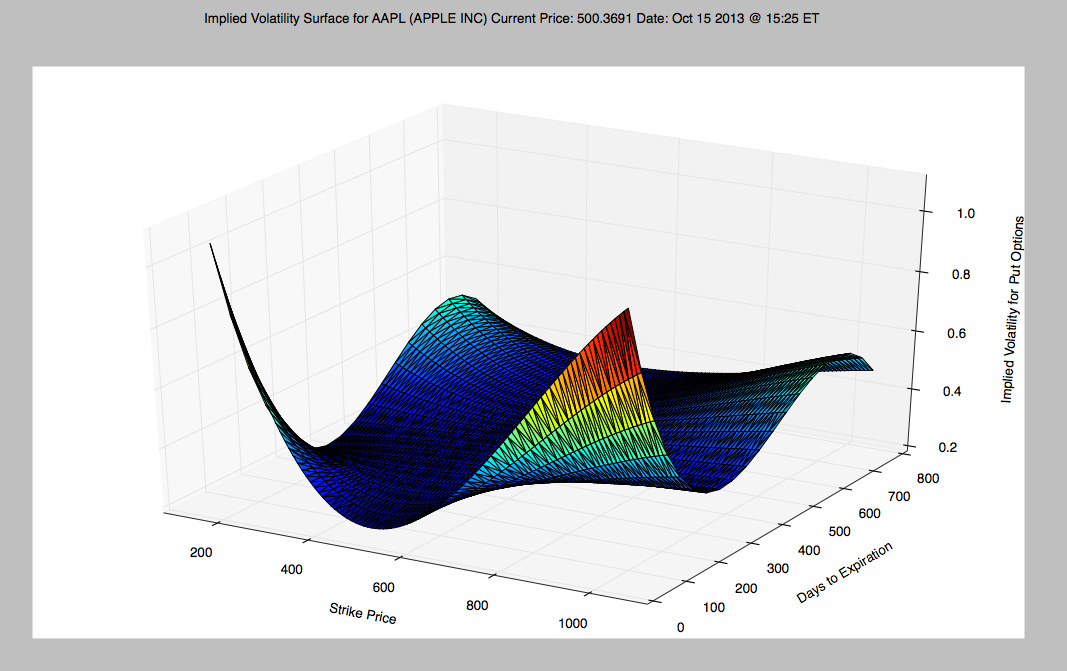
Expression of Volga on the IV Surface
Recall that options have Vega, which measures sensitivity to changes in implied volatility. Convexity reflects the non-linear sensitivity of a portfolio; for options, convexity arises because delta and vega exposures are not constant—they change as underlying prices or volatility move. Convexity in delta is gamma, and so convexity in vol is termed Volatility Convexity (Volga); analogous to gamma (convexity with respect to price), volga is the change in vega exposure with respect to volatility.
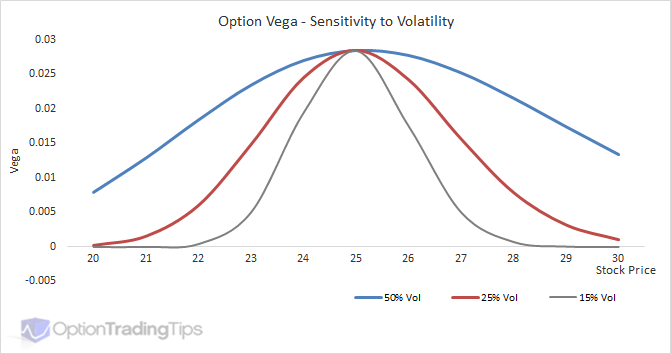
As implied volatility (IV) increases, the Out-of-the-money (OTM) options move closer to the ATM (50-delta) in moneyness-space, increasing their vega (this makes intuitive sense since all are closer to being ATM if vol is sufficiently high). Regardless of IV levels, the ATM options remain at their maximum / minimum vega (this also makes intuitive sense if we note that the payoff of the ATM straddle is linear to vol).
The point here is that OTM options are sensitive to the vol of vol because their vegas can be between 0 and the ATM vega but ATM options have a vega independent of vol. As such, any option structure that is flat in vega space but short ATM must be convex in vol. Just as being long gamma typically requires us to pay theta, we can imagine that being long volga requires us to pay volga-theta; this is one of the reasons why the implied vol surface contains smile (tendency for OTM to be more expensive) in addition to skew (the effect of spot-vol correlation). If there was no smile, then there would be arbitrage since we would be able to get long volga for free.
Expression of Volga in the VIX Complex
The CBOE’s VIX index is an interpolated 30-day implied volatility measure, derived from options on the S&P 500 Index (SPX). VIX futures settle to the index level at the contract’s expiration date, which itself reflects the market’s expectation of 30-day implied volatility at that point in time. If you short a VIX future, you roughly lose linearly to volatility as it rises, since that is what the future is by definition.
However, if you attained an equivalent vega exposure in SPX options to hedge your short VIX position (spread across various strikes), you probably gain on the options more than you lose on the short VIX position if volatility soars. This is since your options would have exposure to volga which the VIX futures by themselves lack.
If you are short VIX futures and long SPX options, you are implicitly long vol of vol. The discerning reader will note at this point that another class of instruments, namely VIX options, can also be used to gain exposure to vol of vol! On a conceptual level, we can roughly say that VIX future + VIX options = SPX options. In other words, SPX options have both vol exposure and vol of vol exposure, and those exposures can be hedged out by VIX futures and VIX options on those futures respectively.
Expression of Volga in Vol / Var Swaps
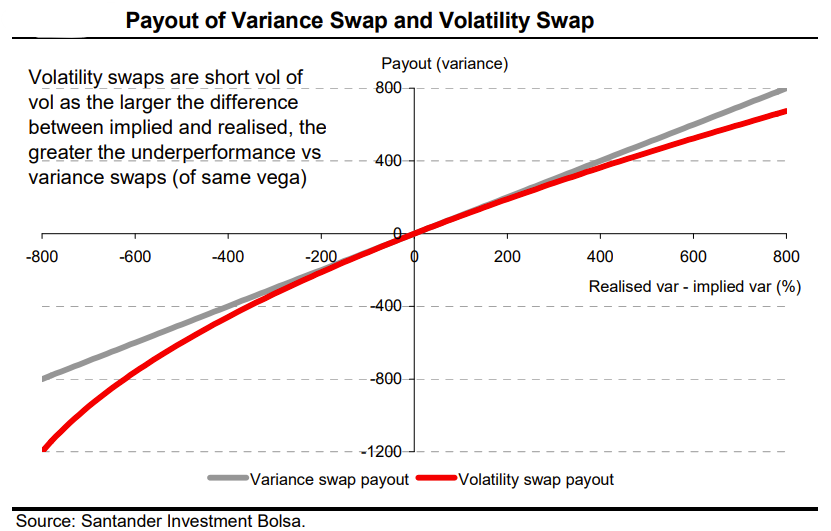
The distinction between variance swaps and volatility swaps directly reflects the impact of vol of vol; variance swaps allow market participants to take positions on realized variance over a given period, while volatility swaps are based on the realized standard deviation. The graph below shows that the payout of a variance swap is always in excess of the payout of a volatility swap of the same vega. This is why the fair level of a variance swap should be (1-2 volatility points?) above volatility swaps. The negative convexity of the payout (compared to a variance swap) shows that volatility swaps are short vol of vol.
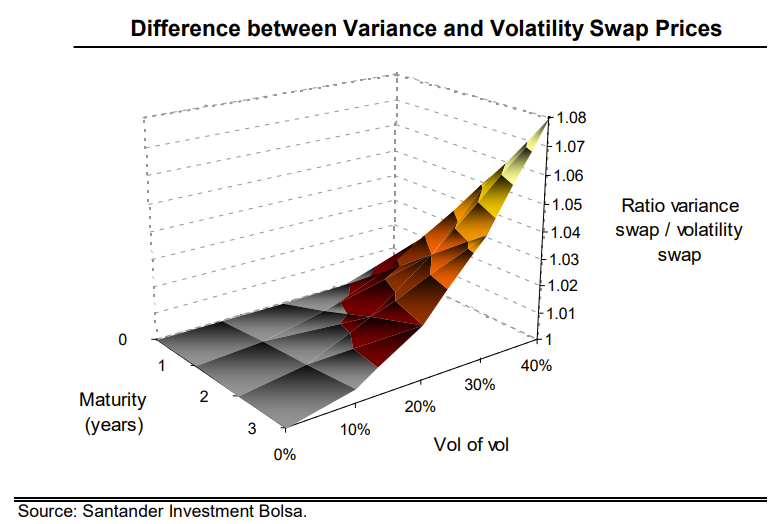
Given that the difference between variance and volatility swap prices is due to vol of vol, and assuming that longer maturities have less vol of vol, it is possible to derive a formula that can be used to approximated by the price of a variance swap less the convexity adjustment to get the price of the volatility swap. See Trading Volatility page 60 for the reference to the formula below
Volga vs Kurtosis (Tail Risk)
At this point, it is important to note that convexity and tail risk are distinct concepts, and while both contribute to the risks of shorting volatility, they operate in different ways. Convexity refers to the non-linear sensitivity of option exposures (such as vega) to changes in the underlying variable, like implied volatility. It explains how risk grows disproportionately as volatility moves higher but does not fully encompass the broader risks of extreme market events. Tail risk, on the other hand, reflects the potential for rare and extreme volatility spikes that can lead to large sudden losses for short volatility positions.
Volatility itself is inherently skewed to the upside due to its bounded nature (it cannot go below zero) and its tendency to experience dramatic spikes during market stress. This asymmetry makes shorting volatility inherently dangerous even without convexity, as the distribution of potential outcomes is already biased toward large, infrequent losses. Convexity contributes to the overall risk but accounts for only a small portion compared to the potential for tail events. It explains why small shifts in volatility can incrementally increase losses, but it is the tail risk embedded in volatility’s fat-tailed distribution that poses the greatest threat to short positions.
In Summary, volga represents the sensitivity of an option's vega to changes in implied volatility, playing a key role in understanding vol of vol dynamics. Unlike ATM options, which maintain constant vega regardless of IV levels, OTM options are highly sensitive to vol of vol as their vega shifts significantly with changes in IV. This sensitivity underpins the implied volatility surface's smile, reflecting the cost of being long volga. In the VIX complex, SPX options inherently carry vol of vol exposure, unlike VIX futures, which are purely linear to volatility; this exposure can be decomposed using VIX futures and VIX options. Similarly, the convexity adjustment in volatility swaps relative to variance swaps reflects their short vol of vol position, with variance swaps priced higher to account for the additional risk from clustering.
Disclaimer
The information provided on TheLogbook (the "Substack") is strictly for informational and educational purposes only and should not be considered as investment or financial advice. The author is not a licensed financial advisor or tax professional and is not offering any professional services through this Substack. Investing in financial markets involves substantial risk, including possible loss of principal. Past performance is not indicative of future results. The author makes no representations or warranties about the completeness, accuracy, reliability, suitability, or availability of the information provided.
This Substack may contain links to external websites not affiliated with the author, and the accuracy of information on these sites is not guaranteed. Nothing contained in this Substack constitutes a solicitation, recommendation, endorsement, or offer to buy or sell any securities or other financial instruments. Always seek the advice of a qualified financial advisor before making any investment decisions.